
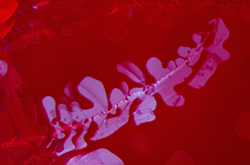
Detecting Corundum Fillers with the Long-Wave UV Torch
There are many benefits to using a long-wave UV torch when testing ruby and sapphire. Here are a few examples.
There are many benefits to using a long-wave UV torch when testing ruby and sapphire. Here are a few examples.

Discussion of gem treatment disclosure and its somewhat difficult history.
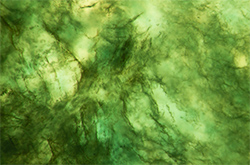
Jade has a long and varied nomenclatural history, with its definition altered in the current age for practical and cultural reasons. This paper examines the hardness of "fei cui" (pyroxene jade) and presents the findings in a simplified format based on empirical evidence and theoretical principles, while also considering the jade hardness data available in literature.
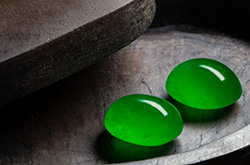
Recent studies show that the gem known throughout the non-Chinese world as "jadeite" jade is actually a rock composed of three major mineral components – jadeite, omphacite and kosmochlor. These components grow in a submicroscopic aggregate with grains so small that normal lab instruments cannot easily determine the true composition. As a result, China's gem trade has adopted the traditional term "fei cui" (pronounced 'fay cho-y') to cover all the pyroxene jades. Lotus Gemology has done the same starting on 1 July 2023, dropping the names jadeite/omphacite/kosmochlor in favor of the scientifically more correct "fei cui."
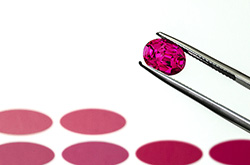
Color types such as "pigeon's blood," "Paraíba" and "cobalt blue" have become wildly popular in the gem trade. But there is a vast difference between coining such terms and applying them in a way that is both consistent and logical. Richard Hughes casts a critical eye on the subject.
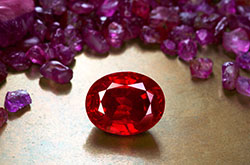
Detection of heat treatment below 1200°C in ruby and sapphire can present challenges to gemologists. In this study, the authors heated Burmese ruby samples and detailed the features that help in the detection of heat treatment.
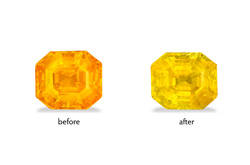
Some yellow sapphires contain unstable color centers. The following discussion outlines case studies of stones that faded after testing in the lab, and how color may be restored.
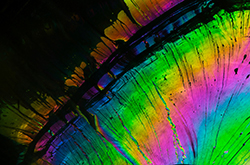
Oil treatment has a significant impact on the appearance of an apatite.
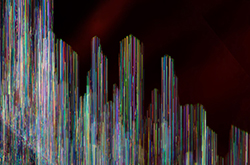
Hogbomite-filled dislocations in a Vietnamese spinel.
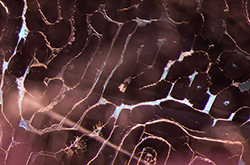
A web-like fingerprint creates a maze-like pattern in spinel.